Remembering the Culture Wars of the 1990’s

-Originally published with The Arts Fuse and now in Franklin Furnace anthology

I was curator of Performing Arts at Walker Art Center in Minneapolis from 1988 through 1996. Our mission was to be “a catalyst for the creative expression of artists and the active engagement of audiences.” We presented 100 performances each season in theaters ranging from 100 to 4,800 seats. Given the mission, I at times produced identity-based performance work, some of which became entangled in the Culture Wars of the ’90s.

First some context: in 1989, the National Endowment for the Arts (NEA) awarded $8.4 million in artists’ fellowships. This represented the apex of these awards. It was also the year photographer Robert Mapplethorpe died of AIDS and Senator Jesse Helms eliminated New York Gay Men’s Health Crisis’ grant of $600,000, objecting to queer content in sex education material.

In 1989, two NEA grants came under political fire. The Institute of Contemporary Art at the University of Pennsylvania used a NEA grant to mount a retrospective of Robert Mapplethorpe’s work, entitled The Perfect Moment, that included homoerotic photographs that some in Congress deemed pornographic. The Corcoran Gallery of Art in Washington, DC canceled this exhibition, anticipating that the content would generate a political storm on Capitol Hill. Some politicians also objected to The Southeastern Center for Contemporary Arts in Winston-Salem re-granting NEA dollars to Andres Serrano because of his Piss Christ photograph of a crucifix submerged in urine.

Cultural Infidels
To mark the start of the ‘90s, the Walker put together a multidisciplinary festival, Cultural Infidels. Historical films by iconoclasts Andy Warhol and Jack Smith were juxtaposed with John Greyson’s Urinal and Isaac Julien’s Looking for Langston. Kathy Acker read from her latest writing, and we exhibited one of David Wojnarowicz’s lithographs. Art and culture were politicized; this is nothing new, and we were eager to support the present-day provocateurs.

Karen Finley performed her profoundly moving We Keep Our Victims Ready. The first night was sold out. Two plainclothes police officers introduced themselves, telling me they were sent to determine if the performance should be closed down. Since this was the first night, I wondered why someone had complained to the police without having seen the work. The vice squad left midway through; there was nothing pornographic.

Critical and audience reaction was rapturous. However, syndicated columnists Evans and Novak wrote about the vice squad visit in The Washington Post, which caught the attention of Senator Helms’ staff. No mention was made of the quality of the performance, only that the vice squad visited the museum in Minneapolis.

Two months later, Holly Hughes made her Walker debut reading an excerpt of Raw Meat as part of P.S. 122’s Field Trips. She returned twice more to perform World Without End and No Trace of the Blonde.

Later that year, still in 1990, choreographer Bill T. Jones spoke to me about a new dance he wanted to create. His partner Arnie Zane had given the piece its title on his deathbed: Last Supper at Uncle Tom’s Cabin. I invited Bill to be in residence in partnership with the University of Minnesota.

Still grieving Arnie’s death from AIDS, Jones wanted to find hope as a gay Black man in America. He envisioned a final resolving tableau of fifty-two nude bodies of all shapes, sizes, ethnicities, ages, and genders. Local dancers, including students from the University of Minnesota’s dance department, augmented his company.

Before the performance at Northrop Auditorium, word came down that the university did not want students to be nude. Despite the warning, they all danced nude.

Some months later, Rev. Fred Phelps and his Westboro Baptist Church crowd protested Last Supper at Uncle Tom’s Cabin when it was performed in their home state at the University of Kansas.

Also in 1990: Keith Haring, who designed Bill T. Jones’ Secret Pastures, died of AIDS, and Cincinnati Contemporary Arts Center’s Dennis Barrie was charged with obscenity for exhibiting Robert Mapplethorpe’s photographs — though after a ten-day trial, all charges were dropped.

Senator Helms pressured the NEA, and individual artist grants to Karen Finley, John Fleck, Tim Miller, and Holly Hughes were denied after being recommended by a peer panel. In a lawsuit, the defendants alleged that the NEA and its Chairperson John E. Frohnmayer violated their constitutional rights by wrongly turning down their applications for grants. (The Supreme Court eventually ruled against the artists in 1998.)

In 1990, “Decency Amendment” language was added to reauthorization language for the agency. All NEA recipients were required to sign a “decency” form. The Walker signed it. There was nothing “indecent” in what we presented.

Oregon Shakespeare Festival, New York’s Public Theater, Bella Lewitzky, Elisabeth Streb, and a few other artists refused. I spoke to Bella about it later. During the McCarthy hearings in the ‘50s, she was subpoenaed to appear before the committee, but slammed the door on the agent telling him, “My dear, I am a dancer, not an opera singer.” She was not going to capitulate forty years later.

The following year, 1991, on Easter Sunday, I presented Diamanda Galás’ Plague Mass at The Guthrie Theatre. The Goth kids loved their high priestess’ depiction of unbearable grief from the AIDS pandemic.

1992 saw Walker presentations of Ron Vawter’s brilliant Roy Cohn/Jack Smith juxtaposing the closet conservative lawyer with the flamboyant performance artist as well as Reza Abdoh’s visceral treatise on serial killer Jeffrey Dahmer, The Law of Remains. Abdoh’s piece was performed in an empty warehouse. The audiences followed deconstructed tableaus of violence, madness, and mayhem, moving through the building, and sitting on the raw floor.

Tim Miller performed My Queer Body that spring. On World AIDS Day, Will Parker sang from the AIDS Quilt Songbook; it was his last concert before he died of AIDS. Two years later, the Minnesota Composers Forum, Arts Over AIDS, and the Walker produced a Minnesota AIDS Quilt Songbook entitled Heartbeats.

Ben Cameron, then head of the NEA’s Theater Program, asked me to be on the Individual Artists panel that year. Given whom I had presented, I wondered if he knew who I was. “Of course, I do, that’s why I want you on the panel,” he assured me. Holly Hughes and Tim Miller received grants.

David Wojnarowicz died of AIDS at age thirty-seven in 1992, two years after he won a historic Supreme Court Case against Donald Wildmon and the American Family Association, who had distorted his visual art in a conservative fund-raising campaign.

In 1993, Huck Snyder, designer for Bill T. Jones’ Last Supper at Uncle Tom’s Cabin, died of AIDS. The Walker showed Derek Jarman’s film Blue. The screen was filled with Yves Klein blue, devoid of moving images, with voice-over narration from Jarman’s diaries. This blue was the color Jarman experienced while being administered eye drops to fend off blindness from AIDS. A year later, Jarman was dead.

Actor Ron Vawter died of AIDS in 1994, as did the fierce Marlon Riggs, who became another flashpoint in the NEA funding controversy when his Tongues Untied was broadcast on the PBS series P.O.V. His black queer ‘reel-ness’ became a lightning rod for malicious conservative outrage.

Bill T. Jones brought Still/Here to Northrop Auditorium in 1994. To develop the piece, he held workshops across the country with people facing terminal illnesses. Newsweek called it “a work so original and profound that its place among the landmarks of twentieth-century dance seems ensured.” Arlene Croce refused to see it, but wrote about the performance in The New Yorker anyway, dismissing it as “victim art.”

Ron Athey
In 1994, I presented Ron Athey’s Four Scenes in a Harsh Life. The work opened with a campy burlesque dance by a Black man, Divinity Fudge, covered in balloons. Ron burst the balloons with a cigar. There was a transition to a scene in which he raised the tattoos on Divinity’s back by cutting stylized marks, patting with paper towels, and sending these blood-marked prints along pulleys toward the audience. Operative words to note: blood-marked prints and toward the audience.

In another section, Ron inserted needles into his own arm as he talked about overcoming addiction and suicide attempts. The iconography of Jesus’ Passion was then evoked with a crown of thorns pierced into Ron’s scalp with acupuncture-like needles. The evening culminated with two performers, Julie Tolentino and Pigpen, being pierced, and ecstatically dancing in a queer wedding ceremony officiated by Ron, now clothed in a business suit, exhorting in a booming revivalist voice, “There are so many ways to say ‘Hallelujah!”

The sold-out performance was well received by an audience of about 100. Post-show discussions with the artist, attended by eighty people, were thoughtful and engaging. Theater and dance critics had been invited — none chose to attend.

Three weeks after the event, a visual art critic from the Minneapolis StarTribune called, wanting to verify someone’s distorted, fantastical version of the performance. She did not want to meet in person and then warned me to look for her lead story on the front page the next morning. Here are some quotes from that initial article: “Knife-wielding performer is known to be HIV-positive” and that the audience “knocked over the chairs to get out from under the clotheslines.”

This was the first of more than twenty articles the newspaper published about a performance its critic had not seen. Vituperative arguments about Athey’s work escalated into fodder for that summer’s NEA’s reappropriation battle because the Walker had received a grant to subsidize the full season of performances, including Athey’s.

When Jane Alexander, the head of the NEA at that time, defended the Walker from the “erroneously reported” and “inaccurate coverage,” the disgruntled local critic fueled the fires by writing directly to Alexander and to Congress, “Your attempts to blame the press for criticism of your agency merely trivializes the issue and obscures the facts.” By advocating directly to Congress, she inserted herself into the narrative; still the newspaper let her continue her coverage.

That local critic also wrote an op-ed piece. While admitting “State health officials agreed there was little risk of audience members contracting the AIDS virus from the performance,” she fired off that presenting this work was “akin to adding blowfish to the buffet of a Japanese restaurant without warning the clientele…potentially poisonous fish whose flesh is said to deliver a peculiar high.”

Walker Director Kathy Halbreich was quoted, “I find the negative responses to this troubling, not because of the artistic issues, but because they’re suggestive of the fear we have of people with AIDS.” The critic’s response was, “Given the complexity of the issues that’s a disturbingly facile response. Somewhere in the background I hear an echo of Clarence Thomas accusing his critics of racism.” Even after this incendiary commentary, the writer continued her reporting for the Minneapolis StarTribune.

Senator Helms called Athey “a cockroach” on the Senate floor. Representative Bob Dornan termed him a “porno jerk” and Senator Clifford Stearns ranted about how Athey endangered the audience’s life by the “slopping around of AIDS-infected blood.”

Minnesota’s Senator Paul Wellstone supported the Walker, as did Congressman Martin Sabo in the House, and Senator David Durenberger criticized the “highly inflammatory reporting…less to do with the Walker — or any single performance — than with the fundamental differences over whether and how the Federal Government should be funding the arts.”

Televangelist Pat Robertson went about tarnishing the Walker’s good name while the American Family Association raised funds by exploiting Athey’s performance. But the strangest solicitation came from the National Campaign for Freedom of Expression. It asked for contributions to defend artists such as Athey. But, to my amazement, the organization used the same decontextualized and demonized descriptions of the artist’s work that the right was using — perpetuating lies and misrepresentations. Good intentions can have unintended consequences.

My mother telephoned after watching Rush Limbaugh. “Buckets of AIDS-tainted blood were intentionally thrown at the audience,” he snidely commented and “the audience ran for their lives.” When I told my mother Limbaugh was a liar, she responded, “But it was on television.”

The amount of hate mail and hostile phone messages I received was astounding. Example: “We got the abortion doctor, you’re next.” Blood-red graffiti was painted on the glass doors of the Walker. The police included my house in their regular drive-bys. Any time I left my home, I would hesitate and look out the windows.

Through it all, Walker director Kathy Halbreich was extraordinary. Leaders do not always get to choose their battles. Halbreich was gracious and supportive under intense pressure, as were the Walker board and staff. Colleagues from the National Performance Network, Dance USA, and Association of Performing Arts Presenters defended the Walker and buoyed my resolve. Local artists, too, rallied. One, Malka Michelson, created a campaign button: “Safe Sex, Not Art — Be a John.”

In 1995, Reza Abdoh, the Artaud of our day, died of AIDS. This was the last year grants to individual artists were awarded by the NEA, except for literature fellowships and honorifics in jazz and folk arts. Art, love, and politics collapsed — an extraordinary epoch was over.

For many artists, validation had not come (at least initially) from the marketplace. The federal government, often leveraging other local and regional support, was crucial. Ending these fellowships had dire consequences, signaling artists were no longer valued on a national level. Many state agencies followed suit. We have been living with the detrimental impact ever since.

Reflections
During the entire summer of the Athey media whirl, not one museum director called Kathy Halbreich to offer support. Peter Zeisler, then head of Theatre Communications Group, called me irresponsible for presenting Ron Athey, although he had never seen him perform.

Other arts organizations facing controversy experienced the same. Few museums supported each other against the vicious, dishonest polemics generated by Andres Serrano, Robert Mapplethorpe, Joel-Peter Witkin, and Chris Ofili. Directors and boards ran for cover when colleagues came under fire. They buried their heads in the sand until they, too, were challenged.

Regional theatres didn’t support performance artists under fire — Karen Finley, Holly Hughes, John Fleck, and Tim Miller — until the Manhattan Theatre Club’s Corpus Christi firestorm or the various protests accompanying Angels in America and The Laramie Project sprung up across the country.

The art world failed to defend its own. The art world got tripped up and confused, supporting only work we liked, but “like” should be criteria at home for above the couch. The lesson: freedom of expression is a more precious commodity than taste. Conservative critics were very clear about their moral imperative; they confidently vilified artists and terrorized institutions. No one won the culture wars — we lost them.
 

When John Cage Composed in Words

Celebrating John Cage’s birthday today, here is my review from the January-February 2017 edition of The Gay and Lesbian Review of “The Selected Letters of John Cage.”

ONE OF THE MOST eclectic artists of the 20th century was avant-garde composer John Cage, who was also a philosopher, a visual artist, and a writer. Cage transformed modernist æsthetics with his embrace of randomness, chance operations, and early adoption of technology in his artistic practice. And silence: in his composition 4’33” (1952), musicians sit in silence and do not intentionally make sounds for four minutes and 33 seconds.

My path crossed with John Cage’s a few times. Once, while I was on tour in the mid-1980s with the Trisha Brown Dance Company in France, I sat in a hotel lobby with him and watched the French Open on television, and then shared a taxi with him to the theater. On the drive over, he repeatedly cranked the car window up and down, amused by its squeaky sounds.

In 1990, when I worked at the Walker Art Center, I invited Cage to do a reading to celebrate the opening of the Jasper Johns: Printed Symbols exhibition. He had written about Johns earlier in his career, and for this performance he randomly rearranged his text utilizing his computer, and presented the resulting concatenation. We had gotten a request for ASL interpretation. Cage was concerned, warning the interpreter that the speech did not really make any linear sense. During his performance, he repeatedly stopped and watched the interpreter, who, of course, also stopped. The bemused Cage then continued reading. Afterward, Margaret Leng Tan performed some of Cage’s compositions on a toy piano.

While his public artistic persona was expansive, Cage was reticent about his private life. When asked about his relationship with his life partner, the great choreographer Merce Cunningham, he would often politely reply: “I do the cooking, and he does the dishes.” While openly gay, neither of them chose to discuss their homosexuality publicly.

However, The Selected Letters of John Cage, which includes more than 500 letters, brings readers intimately into his personal life, beginning in the 1930s, when he was a seventeen-year-old dropout traveling in Europe and Algeria, to shortly before his death in 1992. His affable nature resonates throughout this luminous collection and gives the reader insight into his prodigious intellectual and artistic pursuits. We read his pleas as a fledgling music student to study with Arnold Schoenberg, acquire expertise on Erik Satie and Virgil Thomson’s music, and build relationships with Morton Feldman, Lou Harrison, Henry Cowell, and other emerging mavericks. These composers performed each others’ works in concert and often wrote about each other, since few critics understood the new æsthetic frontiers they were exploring.

Frustration is present in Cage’s missives to orchestra and museum directors around the world as he struggles to earn a living and be taken seriously as a composer. For decades, he was his own booking agent and personally asked people to help underwrite his concerts. He struggled valiantly to establish a center for new music at Cornish School, Bennington College, and Mills College—all to no avail. Tellingly, he wrote to young a composer: “I never made enough money [from my music]to live on until I was fifty. Interrupted my music in order to do odd jobs in order to eat, etc.”

Throughout his life, Cage remained a cultural omnivore. Interwoven into Selected Letters are comments that reveal how his life and art were informed by his study of the I Ching and Zen Buddhism, his burgeoning interest in mushrooms (making him an amateur mycologist), and his embrace of a macrobiotic diet. He aspired to have “all distinctions between art and life removed.” His blending of Eastern and Western artistic traditions placed him at the center of the American avant-garde of the 1950s and ’60s.

Cage’s early notes to Merce Cunningham are beautifully innocent. “I think of you all the time and therefore have little to say that would not embarrass you, for instance my first feeling about the rain was that it was like you. … I would like to measure my breath in relation to the air between us.” Cage became musical director for the Merce Cunningham Dance Company, and together they disrupted prevailing notions of modern music and dance. Aiding their revolution were visual artists Jasper Johns and Robert Rauschenberg, often collaborators on scenic and costume elements.

These relationships, and the masterpieces they created, are gloriously annotated throughout the book. And Cage did so much more than music for the Cunningham dance company. Early letters show him writing to festival promoters to book engagements, sending fundraising appeals to donors and funding agencies, and pleading with fellow artists to donate artwork to make up shortfalls from touring.

Cage’s persistence, entrepreneurship, and unequivocal questioning of the status quo could serve as inspiration for today’s artists who are struggling to forge a career. Ever the anarchist, Cage stated: “I think my activity in the arts is analogous to political activity. It gives an instance of how to change things radically.” The letters in this volume illuminate his creative processes and shed light on how he became a multifaceted artist who has influenced several generations of composers and other artists.


On Twenty Years and Counting

-The Gay & Lesbian Review

My first piece for The G&LR appeared in 2006: an interview with Janis Ian about her then-new album Folk is the New Black. In the intervening decades, I returned to write about her autobiography, an audiobook of the lesbian classic Patience and Sarah that she recorded with Jean Smart, and her “swan song” album in 2022.

Other artists I had the pleasure of conversing with for The G&LR include cartoonist and author Alison Bechdel, upon the publication of Are You My Mother?; choreographer and director Bill T. Jones, on his thoughts about John Cage; composer and performer Meredith Monk, who was celebrating fifty years of artmaking; journalist and author John-Manuel Andriote, about his profiles of queer activists; and filmmaker Angelo Madsen Minax, on trans embodiment.

I also had the opportunity to write about art renegades Peter Hujar, Dona Ann McAdams, Ron Athey, David Wojnarowicz, Tim Miller, and Catherine Opie, along with Jack Lowery’s It Was Vulgar & It Was Beautiful, a scholarly book on the AIDS arts collective Gran Fury, and Sarah Schulman’s first-person narrative about ACT UP, Let the Record Show. An interview with curator Jonathan D. Katz opened the May-June 2025 edition dedicated to his exhibition The First Homosexuals.

Biographies I’ve reviewed include Michael Nott’s perceptive insights on poet Thom Gunn, Brad Gooch’s compelling analysis of artist Keith Haring, and Will Hermes’ definitive treatise on punk icon Lou Reed, alongside memoirs by disability heroes Terry Galloway, Eli Clare, Raymond Luczak, and Kenny Fries. I also covered cultural historian Douglas Crimp’s Before Pictures, which presented a living archive of pre- and post-Stonewall Manhattan. Most recently, in the July-August 2026 issue, I reviewed Tillie Walden’s historical graphic novel Charity and Sylva.

One of my most satisfying assignments was writing about the resurgence of interest in Julius Eastman, an outrageous presence in the avant-garde performance scene in ’70s New York who died homeless and forgotten in 1990. It took decades, but finally the Black gay iconoclast was being celebrated for his musical genius and the sheer audacity of his compositions.

I was honored that my work was included in two special-edition books drawn from the annals of The G&LR that celebrated illustrations by Charles Hefling. Casual Outings included my discussion of John Cage’s letters and diaries, while Outer Appearances featured my synopsis of Keith Haring’s prodigious artistry.

It wasn’t all high art along the way, however. I did some serious diva-dishing on Cher’s albums, her Broadway musical, and her Las Vegas residencies. My blog posts recalled my early dancing days and lessons from the AIDS pandemic. And there were plenty of arts briefs and short reviews of works by Eileen Myles, Robert Glück, Jaime Cortez, and others.

In 2022 I wrote a piece for The Arts Fuse on the history of The G&LR that was republished in the magazine’s January-February 2023 edition. I marveled at the evolution from a black-and-white quarterly to the current glossy bimonthly magazine under visionary editor Richard Schneider. In this article I wrote: “Schneider is always open to ideas and he wields an appreciated editing scalpel that cuts for focus and clarity.”

I remain ever grateful for his belief and support over the past twenty years, and I look forward to contributing to future editions under the stewardship of the magazine’s new editor, Jeremy C. Fox.

The Grand Story of Gran Fury

Recently I was interviewed by Jack Lowery for his upcoming book on the Culture Wars of the 1990’s. Here is a review I wrote on his previous book, “IT WAS VULGAR & IT WAS BEAUTIFUL: How AIDS Activists Used Art to Fight a Pandemic,” that appeared in the March-April 2022 edition of The Gay & Lesbian Review.

Of late, compelling first-person narratives have detailed ACT UP New York’s inchoate years of the late 1980s—notably Sarah Schulman’s Let The Record Showand Peter Staley’s Never Silent—when AIDS activists battled government, pharmaceutical, and religious malfeasance. Flamboyant street actions caught the attention of the media, and artists enlivened the theatricality of these protests. Artistic affinity groups met weekly to create galvanizing agitprop imagery and video documentation. Gran Fury, DIVA TV, and Testing the Limits were some of the art collectives that emerged.

Jack Lowery’s It Was Vulgar & It Was Beautiful examines the legacy of one of these groups, Gran Fury, self-defined as “a band of individuals united in anger and committed to exploit the power of art to end the AIDS crisis.” Their æsthetic appropriated Madison Avenue style advertising, blurring the lines between graphic art and activism, handing out Xeroxed flyers with singular slogans at rallies or pasting posters onto public spaces in late-night, guerilla-style handiwork.

Within a few short years, their work was ubiquitous, seen on posters, stickers, pins, T-shirts, billboards, banners, public transportation, and print ads around the world. None of the collective’s work was ever copyrighted and is still in the public domain. Merchandizing these images supported ACT UP efforts. Their compelling iconography caught the attention of the art world with commissions from museums in New York, Los Angeles, Montreal, Berlin, and Venice. Christopher Knight, art critic for The L.A. Times, enthused: “Gran Fury has produced the most substantive and successful political graphic art of the postwar era in the United States.”

This recognition was complicated. While sponsorship allowed the group to create larger-scale works, at times language had to be modified, and some members thought it was diluting their political propaganda focus. Outrage demanding public actions seemed muted on gallery walls. As some members began to focus on their own careers, others burned out from the ongoing annihilation of the pandemic, leading to the group’s gradual dissolution. 

Lowery tells the story of Gran Fury by drawing from interviews and archival material from ten of its members, and by delving into the ACT UP Oral History Archives organized by Jim Hubbard and Sarah Schulman. The group got its unofficial start when a curator at New York City’s New Museum, Bill Olander, asked ACT UP to create a window installation in 1987 that incorporated Silence = Death iconography and images of such homo-hating political figures as Jesse Helms, Jerry Falwell, William F. Buckley, and Ronald Reagan.

Well over fifty people worked on this installation, which received enormous media coverage. Filmmaker Tom Kalin spoke about participating: “In making Let the Record Show, a bunch of crotchety and opinionated people found a way to work together. And it made us all feel less scared.” With the success of this project, the ad hoc group wanted to continue working together and formally chose the name Gran Fury (after the Plymouth car model used by New York Police). The collective was originally open to all and was quite porous. Eventually the group limited membership for efficiency and productivity.

Lowery’s incisive book functions as a catalogue raisonné of the collective’s œuvre over the eight years of its existence, including fully realized agitprop images and messaging alongside failed or less successful pieces. The latter are understandable, as graphic material was oftentimes quickly produced for planned street actions, sometimes the night before, and images were constantly repurposed. The title of the book comes from an interview with collective member Donald Moffett, a visual artist: “What made ACT UP so effective? … It was vulgar and it was beautiful.”

Highlights include the back stories on some iconic images, including Read My Lips showing two sailors kissing, created for a “kiss-in,” and the Kissing Doesn’t Kill: Greed and Indifference Do poster that ran on buses and subway platforms featuring multiracial couples designed to mimic a highly stylized fashion ad. Their bloody handprint graphic was recycled in many iterations to remind leaders: “You’ve Got Blood on Your Hands.” Gran Fury also designed fake currency dropped onto the trading floor during an ACT UP protest at the New York Stock Exchange, and they tucked their own New York Crimes four-page insert into newspaper vending machines throughout Manhattan to protest the media’s inadequate reporting. In one poster, they reminded the art world that Art Is Not Enough..

Invited to exhibit at the prestigious Venice Biennale, Giovanni Carandente, its closeted director, tried to block their two large panels, The Pope and the Penis, attacking the Catholic Church’s opposition to clean needles and condoms and reprising two of their most popular slogans: “Men: Use Condoms or Beat It” and “AIDS Kills Women,” with an image of an erect penis between them. However, he was not successful in preventing their display at the exhibition.

Gran Fury’s final poster was elegiac. Four Questions was printed in small black type against a large gray background. One of the designers, Loring McAlpin, said this was not a call to action, but a poster “for ACT UP, the Lower East Side, and gay men in New York. We were talking to ourselves.” The four questions were taken from member Mark Simpson’s notebooks: “Do you resent people with AIDS? Do you trust HIV-negatives? Have you given up hope for a cure? When was the last time you cried?”

It Was Vulgar & It Was Beautiful makes a compelling case for the significance of Gran Fury’s imagery to the efficacy of ACT UP. Lowery also sees a larger significance: “Maybe the most important lessons from Grand Fury aren’t about AIDS explicitly, or even about pandemics, but rather the ability for this kind of work to sway public opinion, to shape our attitudes, and to change our worldviews.”

Face To Face With Mortality

-Writing About Our Generation

Swedish death cleaning (decluttering) is fashionable these days and it is indeed happening at our home. At 74, I am dealing with terminal cancer and do not want to leave these tasks to my husband afterward.

At my annual physical last November, I mentioned occasional blood in my urine and getting up multiple times each night to use the bathroom. A CT Scan identified a non-obstructing kidney stone. However, my PSA level was high so my doctor sent me to a urologist. 

More bloodwork showed an even higher PSA level so she ordered a prostrate biopsy and a PET scan which indicated: “Malignant neoplasm of prostate metastatic to bone.” When I asked what that meant, I was told: “We are no longer talking about a cure.” 

Head spinning indeed, from a kidney stone to an incurable prognosis in two months. 

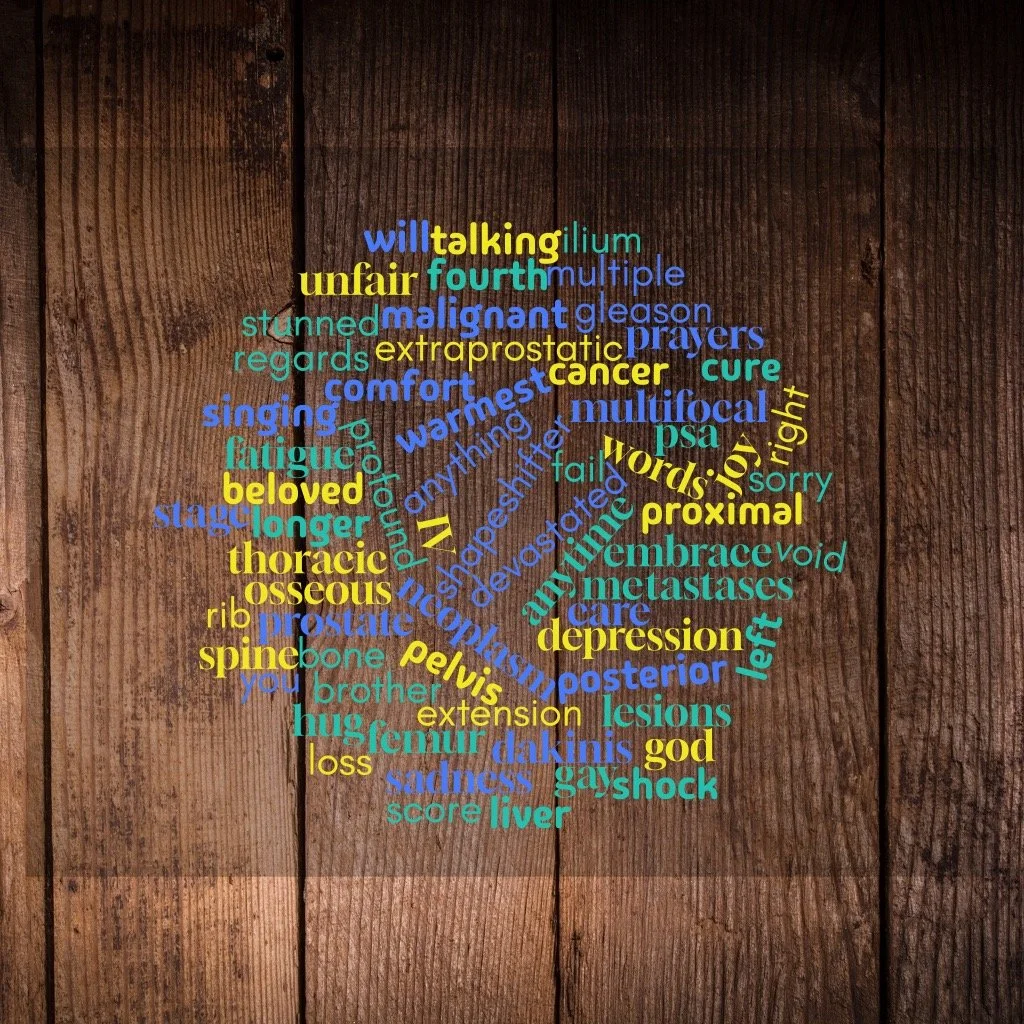
On to the oncologist who confirmed: “Multifocal prostate cancer with extra prostatic extension with multiple osseous metastases pelvis right and left ilium, proximal right femur, right posterior fourth rib, and T2 thoracic spine along with multiple lesions in the liver.” 

I was put on two toxic medications delivered in Caution Hazardous Drugs protective packets. One eliminates testosterone and the other slows the metastasizing in other parts of the body. I passed on chemo as a zero-sum gain. 

My husband and I were devastated, in shock and deep mourning. Friends rushed in with prayers, regards and care. Everyone wanted to visit but that was like moths to my very dim flame. I could not process their grief alongside mine. 

Grateful for emails, cards, texts, phone calls, flowers and short visits. Not helpful: telling me I was going to beat this, suggesting I seek other medical opinions and experiment with alternative therapies. I need friends and family to just be with me. My husband is always there surrounding me with love. He is enough. 

The drugs have severe side effects: sweating, brain fog, fatigue, muscle tone deterioration, loss of body hair and trouble sleeping, along with bone, joint and muscle pain. Women friends empathized with my pharmaceutical hot flashes. My world became very small. 

It is hard not to become my disease. Navigating blood draws, body scans, urology, oncology and palliative care appointments—daunting. Getting bombastic test results before meeting with health providers—scary mind-boggling. 

When complaining about the escalating pain in my legs, a pharmacist suggested one of the meds was known to have interactions with statins which I had been on for years. So, my cardiologist advised discontinuing it to improve my care and now maybe my cholesterol will get me before the tumors. 

My urologist suggested self-catheterizing 2-3 times a day to help empty my bladder. Activities are determined by how close a bathroom can be in every situation. Never expected to be wearing diapers but here I am. 

At night I am up and down hourly which leaves me drowsy throughout the day.

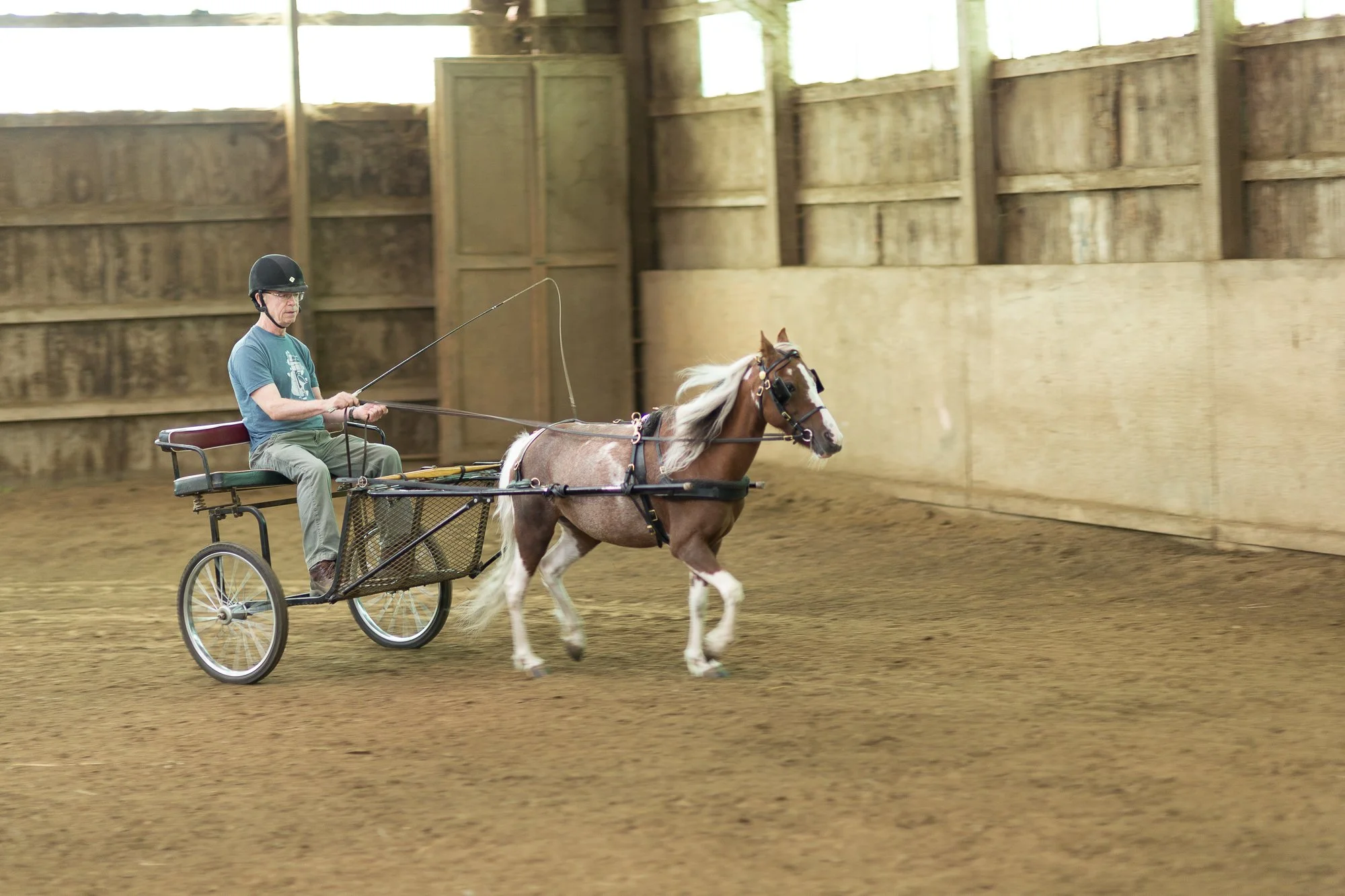
Mornings are filled with Bone Builders exercise classes and barn visits with my beloved 19-year-old Shetland. Art-making is cathartic but not very productive. Naps are ever-present. Nausea complicates meals. Compazine settles my stomach but more pills is not what I am looking for. 

Wills, trusts and advanced care directives are updated as current realities changed our priorities. Goodwill got a good part of my wardrobe and CDs found willing homes. Exhibition catalogues went to libraries and artists; files of articles, speeches and workshops were tossed; and I got rid of copies of my videos, including VHS tapes from the 1990s. 

I kept a few prints and drawings. Online links to major videos are active and my book because art: commentary, critique, & conversation is still available. These traces remain, at least for a while. 

In a recent three-month check-in with oncology, I decided to stop taking one of the drugs with hopes of mitigating the extreme nausea and brain fog. My doctor agreed with my choosing quality of life over quantity with the option to reassess at any time.  

Within days I could focus again and the queasiness dissipated. My husband and I began to go on short excursions for ice cream and gallery visits. I look forward to the weeks ahead. 

“Charity & Sylvia” — A Life Together, in Defiance

-The Arts Fuse

Tillie Walden’s Charity & Sylvia transforms archival fragments into a resonant portrait of devotion in early 19th-century Vermont.

Charity and Sylvia by Tillie Walden. Drawn & Quarterly, 266 pages, $30.

Tillie Walden’s Charity and Sylvia (Drawn & Quarterly) is a beautifully rendered and engaging historical graphic novel that illuminates the lives of a lesbian couple in early 19th-century Vermont. Walden’s work serves as a potent reminder that openly LGBTQ people have always existed, despite their erasure by families, historians, and politicians.

The source material was researched in the archives of the Henry Sheldon Museum of Vermont History, which houses a rich collection of Charity Bryant’s and Sylvia Drake’s acrostic poems, diaries, correspondence, wills, home and business ledgers, and records of charitable contributions. Fortuitously, a niece preserved this trove and donated it in 1897.

The two women lived openly as a same-sex couple from 1807 to 1851 in Weybridge, VT, where they ran a successful tailoring business. Despite some local misgivings, they were largely accepted. Neighborhood children apprenticed with them, and Sylvia served as a deacon in the local Congregational Church.

The partners share a single tombstone in the town cemetery—a remarkable statement in early America. Today, it is well maintained, adorned with pride flags and small visitation stones. In 2025, the state erected a nearby roadside marker recognizing their contributions to the community.

Adapting their story into a graphic format might have posed challenges, given that the only extant image of the couple is a framed silhouette of the two women in profile. However, Walden, the former cartoonist laureate of Vermont, brings considerable skill to the task. Her draftsmanship imbues the twelve panels per page with striking, brown-hued detail, depicting the women caring for one another, as well as their backstories, struggles, family gatherings, and the harshness of New England winters.

Between chapters, Walden illustrates the accelerating pace of the world during their lifetimes: fourteen presidents, rebellions, plagues, the arrival of the railroad, and other technological innovations. These interludes effectively situate the couple’s intimate story within a broader historical sweep.

Walden also renders, with lyrical precision, lists of what the partners loved about each other, alongside the qualities they found maddening. This attention to the emotional texture of their daily lives deepens the resonance of this inventive biography.

In the foreword, Walden writes, “I have also accentuated and changed certain details in the spirit of drama and understanding.” Among the most affecting sequences are her depictions of Charity’s death, with “Sylvia’s hand on her arm as her heart ceases to be,” and, sixteen years later, Sylvia’s final moments, in which she is reunited with her beloved, who reassures her: “They are welcome in his kingdom. They always have been.”

Rather than include footnotes, Walden has created an engaging bibliographic website with extensive annotations, along with notes and sketches documenting her creative process. This companion resource offers deeper access to the couple’s lives, supplemented by historical paintings of the region and examples of period clothing, furniture, and literature.

Upcoming events with the author include Harvard Book Store (MA) on June 10 and The Norwich Bookstore (VT) on June 17. In September, the Vermont Symphony Orchestra will premiere a commissioned work by composer Clarice Assad for orchestra and two vocalists, inspired by the couple’s lives. As Assad notes, the piece explores “how Charity and Sylvia’s courage echoes across centuries—their letters revealing how love persists despite societal constraints in an era where hard-won rights face renewed threats.”

Self-Realization Nation

-The Arts Fuse

John Kapusta’s Self-Realization Nation  traces the influence of Eastern spirituality, politics, and psychoanalytic theories of self-actualization on West Coast “creative counterculturalists” pursuing both personal and societal change. It presents a compelling, well-researched thesis, illuminating the spiritual and aesthetic quests of such figures as Sonny Rollins, John Cage, John and Alice Coltrane, Pauline Oliveros, and Anna Halprin.

Lesser-known artists—among them composer George Rochberg, movement teacher Kay Ortman, and dancer Al Huang—are also examined, with Kapusta refreshingly choosing to focus on process as an indispensable means of freeing and expanding artistic practice. Pertinent examples cited include Cage’s embrace of indeterminacy, particularly his use of chance in composition; Coltrane’s “energy music”; and Oliveros’s sonic meditations. The author also makes a compelling case that Halprin’s task-oriented movement improvisations were foundational to postmodern dance.

As for historical precursors, Kapusta draws on Transcendentalism, John Dewey’s philosophy of self-realization, and W. E. B. Du Bois’s call for Black Americans to pursue self-development. The Esalen Institute is cited as a central hub for many of these artists. Their aim was not only to realize their true selves but also to help others do the same. Kapusta quotes Cage’s civic goal as “not just self, but social realization.”

Kapusta is an academic, and Self-Realization Nation originated as a dissertation; forty-five pages of notes and a twenty-three-page bibliography underscore an impressive scholarly achievement. Still, however compelling the evidence for its premise, the book ultimately feels too narrowly focused. What is missing is a broader consideration of similar trends occurring across the country at the same time.

While it is important to highlight West Coast artists, Kapusta might also have addressed how yoga, Buddhism, and tai chi influenced New York–based figures such as Lou Reed, Laurie Anderson, Meredith Monk, Philip Glass, and Don Cherry, among others. They, too, were transformative “creative counterculturalists” and fit squarely within the book’s themes.

Pollock's Last Lover

-The Arts Fuse

Stephen Kiernan’s novel, Pollock’s Last Lover, is an audacious fictionalized retelling of the tragic final years of iconic American painter Jackson Pollock. Art history purists, beware: the author weaves real people and actual events into his speculative narrative. Willem and Elaine de Kooning, along with Pollock’s wife Lee Krasner, serve as secondary characters. The protagonist is the artist’s mistress, Ruth Klingman, who was in the convertible at the time of his fatal car crash.

Here’s the premise: fifty years after Pollock’s death, the story revolves around attempts to authenticate a painting Ruth claims she was given by the artist in his final days. A (fictionalized) auction house assigns a new associate, Gwen, thirty days to establish the artwork’s provenance. The ensuing investigation is complicated by Ruth’s evasions. Questions of whom—and what—to believe make for compelling reading.

Throughout the novel, Kiernan ingeniously alternates between time periods: flashbacks present Ruth as an aspiring model and part-time gallerist in the 1950s, while we watch Gwen ascend within the auction-house milieu in the early 2000s. The mirroring structure works wonderfully—both women struggle for agency amid personal and professional turmoil.

The author draws on Pollock’s well-documented life, death, and legacy. Detailed descriptions of the Pollock–Krasner home and studio, along with the infamous Cedar Tavern, serve as dramatic backdrops for Ruth’s seduction and her dysfunctional relationship with the artist. Through it all, this is Ruth’s story, not Pollock’s—and her life is as complicated and dissolute as his. There are no happy endings.

In earlier books, Kiernan has situated his historical fiction in the mid-20th century: the personal toll of building the atomic bomb (Universe of Two); a young French woman surviving in occupied Normandy (The Baker’s Secret); and the restoration of stained glass windows in post–World War II France (The Glass Château). His latest novel is a worthy addition to his literary travelogue of the last century.

Brown and Rauschenberg: Forays into Collaboration

-In Dance (2009)

The Trisha Brown Dance Company is celebrating the centennial of Robert Rauschenberg with performances this weekend at BAM, here’s my 2009 interview at Dartmouth with Trisha about collaborating with him.

John: At lunch I joked with Trisha about calling her doctor, since she has so many honorary degrees, but how do you say something to a priestess?

Trisha: You don’t. (laughter)

John: You’ve made over 100 dances, presented thousands of performances, in dozens of countries. In 1985 when you spoke before Congress about the budget for the National Endowment for the Arts, you said, “Artists in this country are not talking about a two car garage, we’d actually be happy with a two coat closet.” Did you ever imagine then, that you would be having the career you’re having now?

Trisha: I imagined it through my dreaming behavior. I had no way of knowing that I could rise this high in modern dance in this country and receive the affection of colleagues and dancers. I have so many memories; I am still uncomfortable with praise that comes to me. My mother didn’t want anyone to brag in her family, so I learned at a very young age, that this was normal.

John: We are here to talk about your collaborations with Bob Rauschenberg, who you described as your “best dance,” but first let’s talk about some history.

In the ‘50s, you graduated from Mills College, studying Martha Graham technique and composition by Louis Horst. In 1959 you attended a workshop with Anna Halprin and met some people who would become important colleagues, Yvonne Rainer and Simone Forti.

Trisha: When I was at Halprin’s, I learned a lot of lessons and carried them with me to New York and used them in early choreographies by myself and other people I worked with. It was quite radical work that was being considered there. I remember once Halprin asked us all to do an improvisation. That was really why I was there, to learn about improvisation. She had her company at the center because they knew how to help her realize what she wanted us to do. Simone Forti, who was a legendary improviser and dancer—she was the cat’s meow. She climbed up over the back of those of us who were down on the deck and she got up on our backs. It is quite difficult to crawl on your knees on people’s shoulders and heads. She got to the far edge of this little group, she leaned way out, she looked down, and I swear to God, she spit. (laughter)

I love these people very much. They were really really good artists. There was this one man who had really thick glasses, and around the corner, out of nowhere, he comes right straight at me and says umBAH, umBAH, three times. I won’t yell it again. I said to myself, “Edge over to this pathway and very discreetly run for it” (laughter). This wasn’t happening any other place in the world.

John: Yvonne Rainer was there that summer as well,

Trisha: Yvonne, and lot of interesting people. Anna invented the thing called “task dance” and meant that you take a tool, like a broom or a cardboard box with some magazines in it, and she says, “Work with this.” I got the broom and was sweeping the deck. It had cracks between the planks and I can get very obsessive about things. There I was, sweeping every crack in the place and then I would take a step forward (demonstrating) and I would go up with my hand and then my arm, up and out. Every time I did this it took me up little higher. I did it until everything came off of the floor and I was flat out on the horizon.

John: Robert Dunn, what were his classes (in New York) like?

Trisha: Bob Dunn had been asked by John Cage to transpose his assignments for music students into dance. He gave an assignment to a small group of us. He said, “Make a three-minute dance.” That was our assignment. I spent hours trying to figure out what could be the difference between a three-minute dance and a two-minute-49-second dance. Who would know? Who would care? (laughter)

Bob Dunn asked us to look at co-students’ work not to tell them what you don’t like about their work, or even what you do like about their work, just watch and tell them what you saw, which is a way of recording back to the students what they had done. That was brilliant!

We were in the Cunningham studio. Merce had lent it to us and then members of his company began to come in, sitting down all around. It became a very rich environment for experimentation and going beyond your normal thinking.

John: That group actually became the nucleus of what was then called Judson Dance Theater, wasn’t it?

Trisha: Yes

John: That’s when you met Bob Rauschenberg. You were in some of his pieces at Judson and he was in your Rulegame 5 in 1964. Talk about you and Bob during the Judson time in your life.

Trisha: Well, we were a village, a community of dancers that took energy from other dancers, and also a collective. We didn’t have any of that judgemental kind of behavior and that allowed people to be very creative. I’d made a dance with a skateboard and Bob—what had Bob done, I’d don’t remember that.

John: Had he done his parachute piece by then?

Trisha: No, that came in Washington D.C. Well, maybe I should just make things up, he’s not here to stop me. (laughter)

John: You couldn’t make up what he would do. He would always top it with reality, whatever you could dream up.

Trisha: We became very close. I have an analogy to our relationship. I like to stand on the shore with one foot and put my other foot into the boat. He liked to stand in the boat and shove off. (laughter) He was more careless than I was. Also he wasn’t a dancer at that point.

John: We want to certainly talk a lot more about Bob Rauschenberg, but before that, I first saw you dance with Grand Union in the gymnasium of the 14th Street YMCA. David Gordon was sitting there with a towel over his head. You and (Steve) Paxton were jumping on each other. What was different about Grand Union from what you all were doing in Judson?

Trisha: Well Judson had to sort out its rules at some point and it was a short period of time when everyone was coming in to see that work. There were some of us who were glued to the windows and back sides of the Judson Church waiting for John and Merce to come and see us. That was a kind of fissure in the trajectory of modern dance development because we did go far, this group of people that I’m trying to describe to you. I have to get a disclaimer because you know those years, ’63, ’62,’64, there was a lot of hanky-panky going on with these rehearsals; there was actually nudity, there was hollering, there was bringing in a yellow traffic divider, setting it down and making a course of some kind. Each person who was there has a different take as to what was going on. I didn’t like it that people smoked dope. I’m a bit square. (laughter) I just didn’t want to do that. It was awkward to mesh this radical group of people into a unity. I don’t think that we made it. I think when we broke out into Grand Union that we became more solid as a working team.

John: It was incredible, one of the most pivotal evenings of my life, made me see things differently. I am very grateful for that evening.

Trisha: That’s a great compliment.

John: From then you began doing more and more of your own work. Throughout the ‘70s you did a lot of “equipment pieces,” performing on museums walls, roof tops, rafts, and walking down the side of a building. Then in 1979, you made another radical departure with Bob Rauschenberg. With Glacial Decoy you made a piece for the proscenium stage. Talk about that piece and why you went from on the walls to behind that fourth wall.

Trisha: Those were rich days for me, because a lot of dancers do not talk to other people, they don’t share other ideas, put it that way. There I had a companion, one of the best, who I could run ideas past him and he could do the same with me. He always wanted to be a dancer. I had a board meeting, he was chairman of my board; someone said, “Trisha should explain to us what her new piece is going to be.” And he said, “Well who is your designer?”

John: For those of you that don’t know, Glacial Decoy has this beautiful four-part set and there were slides of photographs that went across. It seemed to be a trio, but at the end there was a fourth dancer and all had these beautiful see-through gowns. To have a Trisha Brown dance happen in this way was startling to people.

Trisha: I didn’t jump off a cliff on that. I was touring in Europe and I was asked to be on those stages. It just wasn’t seen here, but I got to work a lot on stages.

John: Then in the ‘80s, you had this phrase that I love. “Unstable molecular structures” is how you talked about your dancemaking. What does that mean to you?

Trisha: I work in cycles: Set and Reset came from Klaus Kertess who is an art expert in New York, also on my board, one of my best friends. He referred to the piece as “unstable molecular structure.” Perfect, because I wanted to go from dancing, we didn’t have videotape then, through improvisation to teaching improvisational phrases to my dancers, so it was incremental moves, delicious incremental moves, all over the place. A lot of the dancers, some kind of hijinks welled up within them and they started hiding behind the wings. (demonstrating) Something like this: you wouldn’t see their heads, and a dancer is running down along here, running up that aisle, and this dancer hiding in the wings grabs. (laughter) It led to joy, a tremendous joy in all of us. We broke rules. We invented rules. You couldn’t stop us.

John: Set and Reset had sets and costumes by Bob Rauschenberg with music by Laurie Anderson. It is absolutely claimed as one of the masterpieces of modern dance. I was blessed to work with you during that period. It was clear that a very special piece was being made. Did you know how seminal a piece Set and Reset was while you were making it?

Trisha: Dancers from all over the world were calling in, “Can I have tickets when you come to Paris?” They knew. It wasn’t even very much reviewed in the paper, but they knew about it. There was one performance, I think in Aix, where someone in the audience yelled out, “Happy Thanksgiving” because it was Thanksgiving. (laughter) This phenomenon took its turn.

John: I remember one time Laurie Anderson came to share some of the music she had been creating. She said, “Trisha, do you want the version with words or not with words?” It shows the kind of freedom you give your collaborators, you said “Well, I don’t care, it’s up to you. What do you want?”

In your next cycle of dancemaking—we are now jumping a few years ahead, “Valiant Cycle.” Bob and you did another piece, Astral Convertible. In this piece you asked him to create an inflatable set, but he didn’t give you an inflatable set.

Trisha: Here’s the genesis of this piece: we were in Spain, on the edge of the water. It was a beautiful time, out of doors dancing on platforms and things. The lady who was taking us to dinner said, “Just an incredible thing that goes on here, you should know about it, but of course we can’t have you because you have all those big sets by big artists.” I just thought “uh-uh.” I called Bob when I got home.

John: He created this modular set with the lights that were triggered by the dancers motion—wasn’t that right?

Trisha: There were towers on the stage.

John: And the dancers could move those towers. So you could, in fact, take that piece to that spot in Europe.

Trisha: I like these details sitting on the outside of the frame. The reason this woman was rhapsodizing about these performances was because they happened out of doors in little parks. I didn’t have the electricity. Bob was able to get it.

John: Car batteries.

Trisha: They built towers and on the towers were car radios and and car headlights with a triggering device. Everything came from cars and they were on these towers, two feet high, four feet high, six feet high, eight feet high. They were on wheels and they could be shoved across the stage. When they passed a trigger, the lighting would shift. (demonstrating, laughter) How do you keep up with someone like that?

John: That order and chaos dynamic—you both existed together and were comfortable with it. I think it would drive me completely mad. The next Rauschenberg piece, again is a radical departure, Foray Forêt, which we will see tomorrow night at the Hopkins Center. You and Bob worked on that one together as well.

Trisha: It was a hard one. Sometimes you have magic just flying out of people’s pockets, and other times you have things not going well. Bob wanted to just make the set. He didn’t feel too well during this period. He didn’t want to build a set, he wanted something that was more malleable that he could easily transport. I had a lighting designer who threw lights up on a backdrop to show him what his palette was and Bob made choices from those colors, so it was a big backdrop. As for the costumes, Bob called me up and said, “I just went to the fabric shop and I got you this sleaziest stuff I could find.” (laughter) He was fun. At first he put some kind of brassieres on them. I said, “Bob I don’t think so.” So he put cummerbunds on them, vivid colors and a lot of beautiful stuff.

John: But as you had been making these very opulent, fully theatricalized pieces, you do strip “Back To Zero” in this piece. It’s a perfect part of the program tomorrow night to see the bare essence in a way of some of your earlier aesthetic. Then there is this thing of music in Foray Forêt that is quirky and fabulous–the marching band.

Trisha: I know. (laughter) I was standing on the balcony in Barcelona and I heard Sousa and I thought “Huh? Sounds just like Aberdeen Washington.” I played with it for a long time in my mind. I always call Bob when I was getting into dicey things. I told him I had an idea, “I want you to know what I am doing. This is it: putting the marching band on the exterior of the space, while putting a refined elegant dance on the stage. They will cross the band, will come up behind the wings.” He said, “You know something? I think it’s your best bad idea.” (laughter) So we had to do it, right?

John: For me, it is so poignant when you hear that. Am I really hearing that? It is like a childhood memory for me.

Trisha: Exactly.

John: Last piece you and Rauschenberg worked on, he did the music for. He did beautiful costumes for. He did the lighting for. It was a magnificent solo, If You Couldn’t See Me. But again, it was in a Trisha Brown way. You performed the entire solo with your back to the audience.

Trisha: Yes, this was a very, very important collaboration for me. Bob runs his car off the road every once in a while with an idea and he knows how to go for it. He said, “I got a Yamaha instrument for Christmas. I am down here in Captiva and I am playing on it all the time. All I can see is you, but your back is to me.” It was very spooky, it was haunting. So, I went to work on it. I did ask him, I did have to get a couple of things right with him, “What kind of a costume?” If your back is to the audience, it is a different kind of movement than your front to the audience. In making a piece, any kind of a gesture that comes forward to the audience is talking to them with gestures. If you don’t show the gestures, even if you are standing with your back to the audience, you have to do something like, (demonstrating) something like that. Well, I hope it is a little spunkier than that. (laughter) I’m old!

John: What our friends in the audience are going to see tomorrow night is actually not that solo, but then it morphed into a duet, which is You Can See Us. Describe how it went from being a solo to a duet.

Trisha: Well I was working with Baryshnikov then and he was very interested in certain pieces, that being one of them.

John: Wasn’t it with Bill T. Jones first?

Trisha: Yes it was Bill. He got to it first, but Bill doesn’t have my body and I don’t have his body. It was a real task for me to stay on top of what he was doing. It was difficult to deal with. The next was Baryshnikov. I thought of Misha because he was special in how he did the duet. As you explained, he was always watching me.

John: It was so intimate because this incredible dancer was totally marking Trisha and he was hanging on to her every move for dear life. He was trying to dance in the way Trisha wanted him to dance and it was different than the way he had been trained. I thought it was just beautiful.

Trisha: I had a moment with him on a solo. I came out of very strict abstract movement research. I thought it would be great if he would take on a difficult memory. He made a phrase so pure, so sincere. He was doing something like this. (demonstrating) He was looking this way, and his arms were doing this. He did it so beautifully that I said, “What were you thinking about?” He said, “The last time I saw my mother she was standing on train platform and I know I would never see her again.”

John: The ending section of Foray Forêt is a sumptuous glorious solo that was your solo and this duet was your solo. Both of them were iconic. What is it like for you now to sit in the theater and see other people dance them?

Trisha: I get a little bit cranky. (laughter)

John: So do you see yourself dancing in those solos or are they now the dancers’ solos?

Trisha: They’re gone. I danced for a very long time. I danced about three weeks ago at Danspace with Elizabeth Streb. That was really a lot of fun.

John: One last Rauschenberg story. You were on tour in Naples Italy, with a piece by Nancy Graves, Lateral Pass. The set didn’t arrive. Rauschenberg was there, what did he do?

Trisha: He was making sculptures in Naples. They rented a truck and went all around Naples to junkyards and he got all this stuff and brought it back. Bob walks in onto the stage and dumps out all these little car licenses because they were cutting them up. Bob and his team putting metal together with metal.

John: So it is junk from all around.

Trisha: All around Naples. Bob makes all these beautiful sculptures and they were behind the back scrim. So I said, “I think I am going to make a garden back there, Bob.” Which I did, with these broken reconstructed sculptures. He saw how beautiful [it was] and said, “Can I play in your garden?”

John: I am aware of the time and want to fast-forward through the ‘90s. We could spend so much time there. Again, Trisha Brown changes. I know the Hopkins Center saw the trilogy you did with jazz artist Dave Douglas, but then you started choreographing to Bach, Monteverdi, Webern, and Schubert. It was like “Huh? The woman from Judson is dancing to Bach.”

Lina Wertmuller then invites you to go into the world of opera. Opera is now an amazing component of your life. The third piece we will see tomorrow is an excerpt from a full-length evening of Baroque Opera. What is it about opera that interests Trisha Brown right now?

Trisha: Challenge. I wasn’t sure I could do it. It is really a mountainous awesome piece of music. I think I found my motor in this piece. I love to dance. I love dance. I love structure. I love layering things, and I [had] never taken on a dark drama.

John: For me, so many of your other works play on the edge of stage, whether it is in the wings or walking along the back of stage or your solo with your back to the audience, but in L’Amour au Theatre you seize hold of the center of the stage with luscious dancing. And the backdrop you designed is drop dead gorgeous.

Trisha: Thank you.

John: After you perform here at Dartmouth, the company returns to Europe yet again. As I look at your history, Europe has embraced your work right from the beginning. What are the differences between European presenters, audiences, and critics and Americans?

Trisha: For one thing, they have a larger budget and a Minister of Culture. They give their dancers and choreographers Maisons de la Culture. They have the most exquisite studios. I was offered one at one time, but it was not possible to go because of my dancers and my family.

John: To me you are one of the very few of the greatest choreographers in America today. I think it is a sad statement that you spend more of your time in Europe than you here in the United States. I just want to acknowledge that and wonder if you have any reflections on that.

Trisha: Well, I’m a woman and that’s not the best gender to be in a big competition. I used to speak up about it, but it just alienates men, so I stopped doing that. What I transferred my energies to was helping new choreographers. I never turn a young woman choreographer down if she asks me is she can come over and talk something over with me that is confusing her. I say, “So when can you get here?”

Dance is one of the most fantastic disciplines in art. It comes from the body alone and it comes from the internal aspect of how one thinks and works. We are so fragile out there and we look like behemoths. I don’t understand why there is not more support for it. Maybe in time, like all things, maybe it will get better.

John: Last question. Postmodern. What does that term mean?

Trisha: Nothing. (laughter) No, it was a joke in the dressing rooms at Judson. We were all naming categories of visual art practitioners and someone said, “We were doing postmodern dance at Judson.” We all cracked up and no one countered us. (laughter)

John: I sure hope that the critical discourse is about your choreography and not whether you are a postmodern choreographer because the array of work you’ve made and the different aesthetics you’ve crawled over, under, around and through is so extraordinary.

I am aware of the time. I want to thank Margaret and Jeff for having us. Thank you all for coming. Please come to the performances over the next two nights. It is a very special evening that they brought to Dartmouth.

Thank you Trisha Brown.


Set and Reset: A Moment in Time

As Trisha Brown Dance Company returns to BAM this week performing "Set and Reset" with sets and costumes by Robert Rauschenberg and music by Laurie Anderson, here's a commentary I wrote in 2013 celebrating the 30th anniversary of this iconic work published in BAMbill, VTDigger, and on Vermont Public.

Three decades ago I was Trisha Brown's Managing Director. In fact I was the only administrative staff, working at a desk with a rotary phone in the air shaft between her living and rehearsal spaces.

Arts administration was a nascent field. My most relevant experience was that I had performed and toured as a dancer. I approached each day like rehearsal, building on what I knew and learning what I didn't know - when writing grant proposals, putting together tours, and working with the board to raise money.

Brown's loft building was Valhalla for New York's downtown dance world with illustrious tenants Lucinda Childs and Douglas Dunn, as well as David Gordon and Valda Setterfield. When I had questions, I could simply ride the elevator to get answers. Otherwise, I could go across the street to Paul Taylor's office, or uptown for advice and counsel from Merce Cunningham's staff. There was great generosity in those days; young managers coached each other to success.

When I joined the company, Trisha was developing a new interdisciplinary collaboration with sets and costumes by Robert Rauschenberg and music by Laurie Anderson. The choreography was developed with gleeful abandon. Dancers learned a movement phrase from Trisha and then skittered off to the corners to improvise on it. All encouraged each other to disrupt the proceedings with playful high jinks. Laughter fueled rehearsals.

Rauschenberg created multiple focus points with a flying translucent set projecting black and white stock footage, see-through wings opening up the proscenium, and transparent silk-screened costumes. Anderson built a cacophony of sound by repeating and looping the phrase, Long Time No See amidst clanging bells.

During the final weeks of rehearsals, many of Trisha's collaborators, friends, and art world colleagues came by to visit. Most were enthralled by the sumptuous and lyrically cascading choreography. However, one downtown doyenne dismissed it by telling Trisha she was sure it would be very successful. Success was considered suspect in the avant-garde. Severe intentionality was highly praised, while critical and popular acclaim was disdained.

Well, “Set and Reset” was rapturously received at its premiere, and the success of this resplendent work was game changing for all of postmodern dance, with its investigative rigor, technical virtuosity, and luxurious production values.

Right after the opening, I flew to London with press kits in my backpack, got a Eurorail pass and literally knocked on doors of theaters and opera houses across Europe, to introduce the company's work - communication being a bit different back then.

How wonderful that the Brooklyn Academy of Music is bringing back “Set and Reset,” allowing audiences to once again experience this seminal 20th century masterwork that it commissioned thirty years ago. And affording me, a glorious moment in which to revisit and celebrate.

Remembering Frederick Wiseman

I loved his films. Here’s my review of his 2009 Paris Opera Ballet documentary published in San Francisco Chronicle and Houston Chronicle.

"La Danse: The Paris Opera Ballet," Frederick Wiseman's astoundingly beautiful documentary, has sumptuous delights to satisfy every balletomane. Clocking in at more than 2 1/2 hours, though, it is clearly a film for the committed dance lover.

The 80-year old director remains true to form in his 38th film. He continues his singular style of one camera; full-bodied, extended shots; and crisp, clean edits. In his clear-eyed observation, there are no voice-overs, no talking heads, no fancy edits with graphics, allowing an understated elegance to emerge.

For more than four decades, Wiseman has presented visual material in a vérité style, inviting viewers into what he calls his "reality fictions." In his world, viewers form their own opinions rather than learn through a filmmaker's didactic lens.

Underground labyrinths, backstage corridors, dressing rooms, rehearsal studios, sewing rooms, cafeterias, administrative offices and the personalities that inhabit them embody the film and are in stark contrast to the public's experience of the opulence of the gilded proscenium, scarlet velvet seats, Chagall ceilings, chandeliers and grand marble staircases.

Intimate rehearsal shots detail contemporary choreographers Wayne McGregor and Angelin Preljocaj developing and refining movement phrases step by step. Viewers also witness repertory classics such as "Nutcracker" and "Paquita" being remounted and taught to a new generation. What a pleasure to be brought into the creative process as dancers go about their work unself-consciously.

Juxtaposing scenes of extraordinary dancer-athletes refining their craft are those of administrators in labor negotiations, designing benefactor events and discussing repertory. Occasionally, a snippy remark is captured: "Suzanne Farrell's errors become everyone else's standards." However, we also see the machinations of a huge bureaucracy at work.

Wiseman has an unerring instinct for letting the minutiae deliver meaning. As tutus and other "Nutcracker" costumes are being built by hand, we understand the paradigmatic opulence of the Paris Opera Ballet.

At the end of the film, we see performances of the works, along with choreography by Mats Ek, Sasha Waltz and Pina Bausch. The unobtrusive camerawork and sensitive editing add to the resplendent images that illustrate the fragility and ephemeral nature of dance.

As in his previous films, Wiseman's greatest achievement is observing the mundane and profound without commentary. The whole is indeed so much greater than the sum of the parts of this glorious film - a must-see for anyone who loves dance.

Confrontational Butch

-The Gay & Lesbian Review

Amid the anti-LGBT culture wars of the 1990s, photographer Catherine Opie came to national prominence with a series of images depicting leather dykes and self-portraits featuring cutting and piercing, putting her in the pantheon of late 20th-century queer art photographers who extend from Robert Mapplethorpe’s erotic deviance to Nan Goldin’s diaristic slideshows. Opie’s iconography defied the prevailing censorship of provocative—and especially queer—art led by Senator Jesse Helms and his ilk, but it also challenged anti-porn stalwarts and queer assimilationists.

Since then, she has focused her lenses on numerous subcultures, urban architecture, political rallies, and landscapes, even shooting Elizabeth Taylor’s personal effects. Her creations are collected and shown worldwide. Despite her often flamboyant content, Opie calls herself a “formalist” inspired by the Renaissance portraiture of 16th-century German-Swiss painter Hans Holbein.

In 2024, the Museu de Arte de São Paulo Assis Chateau-briand presented Opie’s first solo exhibition in Brazil, titled Genre/Gender/Portraiture, as part of a year devoted to queer histories, including the work of Francis Bacon and the AIDS activist collective Gran Fury. The exhibition catalog, edited by curators Adriano Pedrosa and Guilherme Giufrida, explores Opie’s painterly influences by juxtaposing 66 of her photographs (taken between 1987 and 2022) with 21 oil portraits by Holbein, Gauguin, van Gogh, Rembrandt, and other great painters from the museum’s collection. This curatorial conceit highlighted the opulence of Opie’s composition as well as her cornucopia of unsanctioned queer desire.

The exhibition featured color-saturated prints of actor Elliot Page, singer Justin Vivian Bond, swimmer Diana Nyad, and performance artist Ron Athey, along with less formal black-and-whites from Opie’s Girlfriends series. Nyad’s muscular, sun-burnished nude backside was exhibited alongside a Renoir and Bond’s demure headshot paired with a Modigliani. Leather “gendernauts” and drag kings were amply represented in images replete with tattoos, piercings, fake mustaches, costumes, and fetish gear. These were intermingled with photos of settled lesbian couples at home. Aristocratic renderings by van Dyck, Rubens, Velázquez, and Manet accompanied them.

The exhibition included Opie’s provocative early self-portraits such as Self-Portrait/Cutting(1993), which focuses on a crude drawing of two female stick figures in front of a house carved into Opie’s back, with the contours still bleeding. Opie wears a black hood in Self-Portrait/Pervert (1994), with needles in her arms and the word “Pervert” carved in oozing letters across her bare chest, an image that was presented alongside Goya’s Portrait of Ferdinand VII. The harshness of these photos was counterbalanced by the sweetness of Self-Portrait/Nursing (2004), which shows Opie gazing lovingly at her son as she breastfeeds. This was ingeniously shown with Bellini’s The Virgin with Standing Child.

The catalog beautifully reproduces her resplendent photographs and their complementary paintings. Insightful essays discuss Opie’s performative staging of issues related to gender, taboo, and the construction of identity, all within the context of familial intimacy. While this body of work represents only a portion of the artist’s œuvre, the exhibition and the catalog affirm her essential contribution to queer representation.


Nayland Blake’s “Dungeon Studio”: Four Decades of Queer Vision and Voice

-The Arts Fuse

Throughout their anthology, Nayland Blake reminds readers of the importance of maintaining authenticity and self-representation in every facet of creative work.

My Studio Is A Dungeon Is The Studio: Writings and Interviews, 1983–2024 by Nayland Blake. Edited by Jarrett Earnest. Duke University Press, 368 pages, $28.95.

This new collection of writing and interviews by the multi-hyphenated creative spirit Nayland Blake, My Studio Is A Dungeon Is The Studio illuminates the rich interconnections among their art-making, activism, curation, and teaching over the last four decades. This is a time filled with government-encouraged erasures and self-censorship, so the volume is an essential read for those interested in pioneering art practices and queer aesthetics.

Blake’s hybrid visual explorations take myriad forms ranging from sculpture and performance to video and installation. Their various installations, found-material sculptures, puppets, drawings, costumes, performances, and videos invite viewers into the artist’s fears, fetishes, and delight, places where they explore gender, kink, and racial norms. Their work has been widely exhibited, collected by major museums and is represented by the Matthew Marks Gallery. MIT’s List Visual Arts Center hosted a retrospective, entitled No Wrong Holes, in 2021.

Early in their career, Blake co-curated, with Lawrence Rinder, In a Different Light (1995), a show at the Berkeley Art Museum that examined the impact of queer sensibilities on contemporary art before the reframing that came with AIDS. These early influencers included Fluxus renegades from the ‘60s as well as feminist icons from the ‘70s. The catalogue has become foundational in understanding LGBTQ art history.

In 1996, Blake moved to New York where they continued to create provocative intermedia objects as well as curating and lecturing. They are currently the co-director of the Studio Arts Program at Bard College. Throughout their career, Blake’s commentaries have appeared in a wide array of publications. A potpourri of these writings, along with some unpublished material and transcribed conversations, is featured in this new compilation.

The pieces here are eclectic, ranging from the academic to the playful. Transgressive performance scripts on racial hybridity and sadomasochistic practices are interspersed with pieces that are nonlinear, intentionally self-conscious, and profoundly personal. Less serious is a Tom of Finland appreciation and excerpts from pornography reviews they wrote for the gay weekly Bay Area Reporter. There’s a “sci-fi porn story” thrown in for good measure.

For creatives, Blake provides helpful tips on coming up with artistic statements, “100 Assignments” for curriculum, as well as art-making and self-improvement ideas. Also included: loving musings that celebrate Jack Smith’s sexy camp extravagances, Nancy Grossman’s misunderstood leather-masked sculptures, Ray Johnson’s hermetic collages and mail-art, and Kathy Acker’s punk appropriation of found texts that focus on abject themes.

Blake’s interviews and other essays illuminate the intersection between the artist’s sexuality and their work: “I started making art that tried to overlay these two experiences on top of each other, finding narratives to fit the technology and props of BDSM. I saw what those two worlds had to offer each other, and I tried to help others see it.”

Throughout the anthology, Blake reminds readers of the importance of maintaining authenticity and self-representation in every facet of creative work. Artist, writer, educator, and curator – for them, it is all the same practice. The landing page of Blake’s website sums up their inspiring activist sensibility: “Teach it – Promote it – Create it – you are responsible for the continuation of the culture you love. Keep it alive through your actions.” A resonant credo for all!

The Woodcutter's Christmas

-The Arts Fuse

In 2001, writer Brad Kessler and photographer Dona Ann McAdams collaborated on The Woodcutter’s Christmas. Inspired by her photos of discarded Christmas trees, Kessler penned a tender holiday tale of a farmer’s annual trek from Vermont to sell his family’s stock of trees to Manhattanites.

The slender volume has long been out-of-print. However, Galpón Press has released an updated edition with expanded text by Kessler and additional pictures by McAdams. There is so much to love in this book. The poetic prose — illuminated by austere black and white portraits of abandoned trees — is a resonant parable for all ages.

The story centers on a family’s fascination with a man who, every December, unpacks his truck and sets up an open-air bazaar of Christmas trees below their windows in the East Village. One night the reclusive salesman asks for help; he needs someone to watch his wares while he picks up a part to repair his truck. A meal is shared, and he scribbles his address, “Var’s Farm, Dedham’s Notch VT” on a matchbook cover. After that Xmas, he never comes back to that location.

Several years later, while returning from a ski trip in the Green Mountains, the family notices the Dedham’s Notch exit on the highway and decides to make a detour to visit the enigmatic farmer. Sitting by the man’s wood stove, the family learns that he became angry that his beloved trees were so quickly left for curbside trash. Disgusted, he filled his truck with the detritus and returned the trees back to the land, vowing never to return.

The story culminates with an agrarian miracle — the characters sit on the farmer’s porch, listening to the wind and trees as snow falls. It is a Zen moment in a sweetly spiritual yuletide fable that deserves to become a holiday classic.

Finding Hope In Corporeal Agency

-Writing About Our Generation

In my artistic practice, I often return to making personal narratives eulogizing the body as offerings. In the 1990s I created elegiac videos commemorating and mourning those lost to AIDS. It was important to make the body sacred again. When I became physically disabled in 1996, my work then celebrated maligned bodies.

I find hope in taking action, especially with other like-minded artists. No different than political street protests throughout my lifetime, i.e., the 1968 Democratic convention in Chicago, Gay Liberation marches in New York, and No Kings rallies today.

After last fall’s elections, I was afraid. I’m 73 years old, paraplegic and queer. I feared for my community and reached out to friends to participate in a new project asserting our corporeal agency. I needed to feel safe. Joining me were cisgendered and trans folks, queer and straight, with varying abilities.

I asked participants to reclaim a part of their body. I thought of it as a political act of affirmation. We shot in slow motion close-ups that revealed the impact left by injury, disability and the passage of time. No faces were revealed, resulting in a meditative collage. The only didactic was in the end titles, “Our differences reveal our humanity.”

The “Corpus” video became a component in an installation currently on view at the Burlington City Arts Gallery in Vermont in a group exhibition, “Do We Say Goodbye? Grief, Loss, and Mourning.” Alongside the video, a tattered latex shroud of my face is displayed as a decaying relic, while a pile of burlap lies crumpled on the floor. Stenciled on the burlap are four phrases: “dissolve expectations,” “observe without judgment,” “surrender into ease” and “learn from the body.”

Surrounding my installation are sculptures, paintings, drawings, photography and video by other artists exploring themes of “memory, empowerment, transition and endurance.” I am blessed to be in such company. Given the exhibition’s theme, I initially worried that my work would be read as only grieving, not also celebratory. However, this has not been my experience with gallery visitors.

One university art student felt my theme was accepting and working with the bodies we are given. A woman in a senior center tour tearfully spoke about her embedded pain and trauma. I was on a panel with the Vermont Association of Psychoanalytic Studies exploring stigmas surrounding grief and how art can provide comfort, resiliency, and mental well-being.

My project felt necessary, creating a metaphorical space to hold me and my community safe. As it now makes its way into the world, will it change hearts and minds? While my intention, it is not my call. As Marcel Duchamp reminded us more than 60 years ago, a work of art is completed by the viewer: “The onlooker has the last word.”   

Https://Vimeo.com/1058747731?Fl=Pl&Fe=Sh

A Portrait of Fakir Musafar — The Search for Corporeal Transcendence

-The Arts Fuse

A Body To Live In is not trying to be a conventional biopic — this is an atmospheric reminiscence of an underground movement.

Angelo Madsen’s films are steadfast in how they unapologetically portray queer otherness. His latest effort, A Body To Live In, is a documentary on Fakir Musafar, a pioneer of extreme body modification. It is a loving, clear-eyed portrait of a complex icon as well as a celebration of the communities — interested in exploring transgressive sexuality and spiritual seeking — that gathered around him.

Musafar was a central figure in San Francisco’s underground kink scene in the ’70s and ’80s. He came to national prominence when the punk ‘zine RE/SEARCH profiled him in its 1989 “Modern Primitives” edition, anointing him a shaman-like visionary who believed that tattoos, piercing, ritual scarification, and flesh hook suspensions were vehicles for ecstatic experiences.

The filmmaker met Musafar in 2004 and they remained friends until his death in 2018. He was given full access to the artist’s archives, including photographs, writing, and hundreds of hours of film, video, and audio recordings.

Dexterously collaging this material with interviews with Musafar’s wife, Cléo Dubois, performance artists Ron Athey and Annie Sprinkle, as well as other surviving elders, the documentary is an immersive dive into what had been a thriving subversive culture — before the moral panic of the ’90s and AIDS obliterated so many of its enthusiasts.

Musafar constructed a complicated persona, whose contradictions the film explores. Born Roland Loomis, he began his adventures early on; we see photos of him, as a teenager, in his parents’ basement, staging clandestine explorations of bondage and piercing that he hoped would produce out-of-body experiences.

Influenced by magicians and carney freak shows, Loomis appeared at tattoo conventions and fetish balls in the ’70s under the pseudonym Fakir Musafar, the latter a 12th century Sufi mystic. His notoriety spread through writing, lectures, film, and photography exhibitions, In 1992, Musafar opened his own piercing school for acolytes.

The documentary deals with Musafar’s followers along with his skeptics. Footage of joyous participants piercing each other, drumming, chanting, and dancing in outdoor fields is juxtaposed with criticism about appropriation of indigenous sacred rituals. Television talk show hosts are left aghast, asking Musafar how he could do these things to his body. Musafar — usually in a suit — calmly responds with a beatific smile.

Musafar’s wife discusses how her husband existed between genders (“being in the cracks,” he would say). There are ample segments of him cross-dressing. Leathermen, radical faeries, dykes, and gender non-conforming folks were welcomed into this subculture, which was dedicated to the quest for corporeal transcendence. A Body to Live In‘s memorable culminating scene shows Musafar and his wife suspending a male partner on hooks as the three tenderly embrace.

Serving as director, producer, and editor, as well as creating visual effects and the sound score, Madsen delivers an emotionally propulsive journey. A Body To Live In is not trying to be a conventional biopic — this is an atmospheric reminiscence of an underground movement. Madsen’s technical and aesthetic approach here is in the mode of what French New Wave director Agnès Varda called cinécriture: using “the cutting, the movements, the points-of-view, the rhythm of films and editing” in the same way a writer chooses “adverbs, paragraphs, asides, chapters which advance the story or break its flow.” The camera rarely lingers on interviewees; instead, they function primarily as voiceovers accompanying the plentiful historical footage. Abstract interstitials are used to effectively represent trance-like states.

Interspersed throughout the documentary are poignant excerpts from audio interviews that were made in the last weeks of the subject’s life. The film concludes with Fakir Musafar stating: “I’m ready to give the body up and just be spirit for a while, consciousness.”

Massachusetts College of Art and Design is presenting two evenings of Madsen’s previous works as part of their Ciné Culture Series on October 1 and 8. A Body To Live In will receive its New England premiere on October 19 at the Vermont International Film Festival in Burlington. His work can also be seen on Criterion, Mubi, and New York Times Op-Docs.

Arts Fuse 2022 interview with Angelo Madsen.


Dona Ann McAdams Governor's Arts Awards introduction

-Vermont Arts Council

Photo by Ali Kaukus

I am the luckiest person in this room because Dona Ann McAdams is my friend. You don’t often get to be friends with your heroes. Fifty years into her remarkable career she is still capturing indelible images of art, politics, and community.

As the house photographer for P.S. 122 in New York, she was revered by artists as a collaborator who could illuminate their art beyond the stage. This body of work won her Obie and Bessie Awards.

In the ‘90s, David Wojnarowicz, Karen Finley, Ron Athey and others became flashpoints in the Culture Wars. Dona had photographed them all. Despite intense pressure (and financial incentives), she protected their images from being sensationalized in conservative media.

Dona is also a street activist, an engaged social agitator capturing queer liberation, ACT UP, antinuclear, and pro-choice protests in the ‘80s and '90s. This agit-prop sensibility continues today with photos of Christine Hallquist in a Pride Parade, Black Lives Matters marches, and anti-Trump protests outside the White House. 

Her portraits of people living with mental illness, rural farmers, cloistered nuns, and backstretch workers demonstrate her profound empathy with her subjects, illuminating the joy and dignity in these “unseen communities.”

Moving to Sandgate in ‘98 with her husband writer Brad Kessler, neighboring farmers and their work animals became her camera’s focus, along with documenting the backside at Saratoga Racetrack.

She invites the viewer into the particularity of place and the innate humanity of the people she captures. She never stages photographs, never “move there” or “look this way.” Yet her framing is flawless with the edges as essential as the center.

And her majestic portraits of animals: horses, cows, dogs, and her beloved goats! When Green Mountain College decided to put one of a pair of oxen down after an injury, animal rights activists protested. So, what did Dona do? She went into the pasture with Lou and Bill producing a beautiful depiction of elegance and power — another political act with a social conscience.

I love Dona, her politics, and her aesthetics. One of my career highlights was curating “Dona Ann McAdams: Performative Acts,” that toured to Brattleboro, Rutland, St. Johnsbury, Stowe, and Bennington.

At 71, Dona is not slowing down. She’s still shooting with her Leica cameras and printing resplendent black-and-white images in an analog darkroom. She’s old school indeed, but not nostalgic – most excited about what she is filming today and planning for tomorrow.

Last year Saint Lucy Books published BLACK BOX: A Photographic Memoir. Brattleboro’s Vermont Center for Photography and Pratt Institute’s Manhattan Gallery presented companion exhibitions.

This summer, she was once again ensconced at Saratoga Racetrack. And ask her about Lincoln’s hat at Hildene. Her work is currently on view at The Current with another exhibition opening next month at UVM and one being developed for here at Southern Vermont Arts Center next year.

This is indeed Dona Ann McAdams’ time. I am thrilled she has been recognized with the 2025 Governor’s Award for Excellence in the Arts.

Shape-Shifting Memories

-The Gay & Lesbian Review

A  genderqueer person living with cerebral palsy, Eli Clare uses writing as a bully pulpit against trans and disability oppression. His newest book, Unfurl: Survivals, Sorrows, and Dreaming, is a balm amid the Trumpian obliteration of diversity, equity, and inclusion initiatives and trans identities. His writing is infused with a passion for social justice.

Clare has previously written two books of essays and a collection of poetry, in addition to being published in dozens of journals and anthologies. His award-winning Brilliant Imperfection: Grappling with Cure (2017) challenged the medicalized disability narrative of defective brokenness, and he debunked the ableist “inspiration” porn objectifying people with disabilities through the adept use of historical research, memoir, and poetry.

The new book’s journey began eight years ago when Clare was commissioned to write text for a performance by the Kinetic Light disability arts ensemble. In the intervening years, the deaths of family members and friends, along with Covid, affected his work. In 2020 he was awarded an unrestricted grant of $50,000 as a Disability Futures Fellow funded by the Ford and Mellon foundations, which allowed him to concentrate fully on writing for more than a year.

Unfurl continues his interweaving of creative nonfiction prose, poetry, memoir, history, and advocacy. Topics are ever shape-shifting: painful flashbacks of childhood abuse interspersed with dreamscapes engulfed by gorgeous environmental metaphors, as well as erudite critiques of classifications and nomenclature. Resiliency and healing are central to his perspective. Tender ruminations of stumbling strides and crawling across forest floors invite other people with disabilities to break normative strictures and “scoot, slide and crawl” with him. Timid teenage poems are reconceived with empowerment and affirmation. Intergenerational trauma is examined, not to forgive but to break the chain of “survivor turned perpetuator.”

Clare’s writing is intentionally free of academic jargon and is further made accessible through visual format notes on poetry spacing, historical context, endnotes, and content warnings. These layers add to the flow of the book, inviting the reader into multiple ways of experiencing the writing. Community is important to the author; lost heroes are commemorated. “Justice dreamers” are acknowledged, emphasizing collective care and liberation. Also essential is his self-caring embrace of the natural world: “Sitting in the woods or at the ocean, I glimpse a world that relishes crookedness, wholeness and brokenness.”

In his recombinant synthesis of mixed genre writing, Clare provides a road map to create joy and freedom in the face of formidable societal obstacles. His journey is testament to a path forward as he reminds us: “It is time/ to listen to our grief and soothe our jangled/ nerves—we must not relinquish imagination.” In an interview, the 62-year-old artist expressed his concerns about the current storm of anti-trans hysteria: “They are going to fail. There’s no way that they in the long term will erase trans, nonbinary, and gender-nonconforming people.” He hopes the book will “strengthen people’s ability to disobey, resist, and rebel.” And he plans to be “available for as much street protest as my body can sustain.”

In times of despair, the arts will continue to deliver hope

-The Other Paper

Sixty-two years ago, I was shepherded out of an elementary school classroom and into church to pray for the assassinated President Kennedy. Bob Dylan’s “Blowing in the Wind” was on the radio. In high school, I protested at Chicago’s Democratic National Convention.

Fifty-two years ago, I bought a one-way ticket to New York to pursue my dream of becoming a dancer. I found community with other gay men, although we had no legal protections; we could be fired from jobs and evicted from apartments. Our sexual activity was criminalized.

Forty years ago, I managed Trisha Brown’s dance company with a rotary phone and rolodex. With press kits in my backpack and a Eurail pass I knocked on doors of theaters and opera houses across Europe introducing the company’s work.

Thirty-one years ago in Minneapolis, I was inundated with hate mail during the Culture Wars. The AIDS pandemic was obliterating an entire generation. My artwork eulogized and mourned. Later, complications from spinal surgery left me paraplegic.

Twenty years ago, I worked in arts administration and philanthropy in San Francisco while creating disability-inflected videos and essays. I married my husband and rekindled a childhood love of Shetland ponies. With equine in tow, we moved to Vermont in 2010.

Seven years ago, I retired from running the Flynn Center and served two terms in the Vermont House of Representatives. Writing and media projects continue, along with exercise and daily chores at the barn. I am steeped in the realities of aging.

In each of these decades, optimism raged during boom times and despair in downturns. While political, demographic and environmental forecasts appear dystopian, I am buoyed by the grass-roots resistance and resiliency experienced in my lifetime.

As an artist and activist, I learned to trust the process, improve on what worked and drop what didn’t. Failures and mistakes fueled advances. I made work to survive and thrive in darkest times. From lived experience, I am certain cultural investments now will better prepare us for whatever cataclysms lay ahead.

Even in our Trumpian hellscape of eliminating the arts, humanities, DEI initiatives and trans identities, I dream of inclusive communities revitalized, people sharing common ground through artistic engagement, children finding voice with arts education, and artists providing succor.

The arts are where hope lives. And we need buckets of it right now. Artists create vivifying metaphors, define space (real and imagined), commemorate losses and victories, and articulate the unconscious, engendering a safe space for unsafe ideas — a necessary role in our profane world.

Recently, I worked with a community of artists to claim our corporeal agency. Joining me were cisgendered and trans folks, queer and straight with varying abilities creating a meditative video about our bodies that have been damaged, feared, demonized, weaponized, politicized.

The project felt necessary; this is my offering. Will it change hearts and minds? That’s not my call. As Marcel Duchamp said, “A work of art is completed by the viewer.”

Five years from now, I will have reached my average life expectancy. In the near-term I focus on what my service can be today, believing a society we conjure together will flourish. The future is now.

We need to support artists in Vermont

-VTDigger

In 1973, I left Chicago on a one-way ticket to New York to pursue my dream of becoming a dancer. Part-time jobs and unemployment subsidized my performing career. In between tours, I finished my college degree in psychology. 

After I stopped performing, I managed two dance companies in New York, worked at contemporary art centers in Minneapolis and San Francisco with stints in philanthropy and ran the Flynn Center in Burlington. After retiring from the Flynn in 2018, I served two terms in the Vermont House of Representatives. As I moved through the world, I was blessed to have my husband willing to relocate. 

All the while, I never stopped writing personal essays and making films. Complications from a spinal surgery left me paraplegic nearly three decades ago — and yet, my art background served me. While kinesthetic connections in my legs were lost, I learned how to walk again in front of mirrors, just like I did in dance class.

Now retired from day jobs, what a joy it is to wake up every morning and imagine, “What can I make today?” 

I finished my 21st short film and have a print on view at T.W. Wood Gallery in Montpelier with an installation opening next month at Burlington City Arts Gallery. Videos of mine were broadcast this summer on Vermont Public and Maine Public. While tremendously validating, there is little financial reward. Even with grants, commissions, royalties, publishing and broadcast fees, breaking even remains aspirational.

Last year, Vermont Arts Council awarded creation grants of up to $5,000 to 22 artists, which cover a portion of their estimated expenses. Winners are only eligible to apply again after a five-year waiting period. So, few can realistically pursue an artistic career full-time locally. 

National opportunities are ever slimmer. Federal arts and humanities grants that had already been awarded were clawed back and the Corporation for Public Broadcasting just announced it will be closing after losing its funding. Art-making in America remains avocational.

In our fractious times, further capitalizing the arts seems prudent as culture demonstrably builds community and creativity sparks innovation — necessary components for a path forward. Science, technology, engineering and mathematics, or STEM, curriculum is enhanced when you add the ‘a’ for art to provide STEAM problem-solving in our schools. 

Making work is stimulating and filled with wonder. I wish this for others.

Artists are often among the first responders in political protests with potent iconography. The Civil Rights, Queer Liberation, Reproductive Freedom for All and Black Lives Matter movements are pertinent examples featured in the multidisciplinary exhibition, “It often rhymes” at The Current in Stowe. 

These kinds of voices are essential to democracy. In our current Trumpian apocalypse, clarion dissenters are even more necessary, along with soothsayers offering hope.

Artifacts from every epoch are indicators of the vibrancy of that society. It is the disruptors that are often remembered. In art (as in politics), change happens from the fringe. What will our legacies be? For an emboldened and transformed future, invest more deeply in artists. They begin, and begin again.